
Lighter Bodies, Lighter Bones? Skeletal effects of semaglutide

Weight loss drugs with semaglutide as their active ingredient, like Ozempic and Wegovy, have transformed obesity treatment, but while much of the conversation focuses on shrinking waistlines, a lingering question remains unanswered: what happens to the skeleton supporting this lighter body?
The rapid weight loss by semaglutide is no news, and the fact that all the loss is not exclusive to fat, also not news to many. Lean mass and bone are included in the loss. In fact, studies that yield weight loss by caloric restriction alone have also reported loss in bone density (Chlebek et al., 2026). Yet, little is known about the effect of semaglutide on bone health.
Katelyn Eisner et al., from the Wright lab at the University of British Columbia in Vancouver, Canada, designed a clever experiment to shed light on this uncharted territory, and published their finding in their paper, titled
Negative effects of semaglutide on bone in obese mice
published in Cell Reports Medicine, in June 2026.
They fed mice (male C57BL/6J) for 12 weeks with a high-fat, high-sucrose diet (45% kcal fat, 35% kcal sugars and carbohydrate, 20% kcal protein) to induce obesity.
Mice were split into three groups, where one received semaglutide, the second received the vehicle (the drug, without the active ingredient, semaglutide), and the last group was the pair-fed group, which received the same amount of food as semaglutide group without the drug, as shown in their graphical abstract taken directly from the paper, with permission. Having the pair-fed group allows distinguishing which effect is due to semaglutide and which is due only to caloric restriction, knowing that semaglutide will cause a massive reduction in appetite and hence in eating.
The authors followed up the semaglutide treatment with a 6-week withdrawal period to check if the effects are reversible. Upon the six-week completion, they measured skeletal integrity.

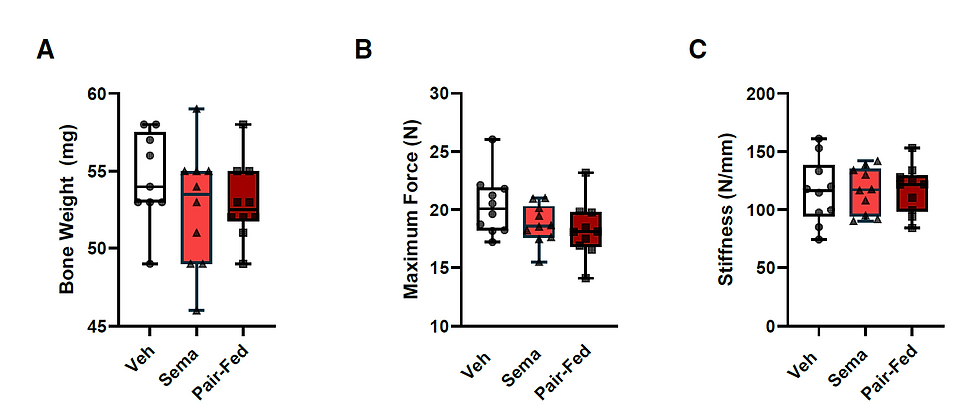
After the 4 week treatment, group that received semaglutide experienced ~9% reduction in femur weight. They asked if lighter femur weight would correspond to weaker bones and unsurprisingly, it did. Using a three-point bending test, biomechanical assay that measures the force required to break a bone, they found that femurs from semaglutide-treated mice required approximately 13% less force to fracture compared with controls. Bone stiffness, a measure of resistance to deformation under load, also declined as depicted in the Figure 1, C; taken from the paper.
The pair-fed group that had 4 weeks of caloric restriction did not yield the same degree of bone weight and strength loss Figure 1 A-C/ pair-fed column.

They next wanted to check how is bone density is being reduced. Is it the bone formation that is being impacted or is it the bone resorption/ breakdown. Two specialized cell types regulate bone health and they are the osteoclasts (cells that break down old bone), and the osteoblasts (cells that form new bone). The authors measured markers of both osteoclasts and osteoblasts.
Intriguingly, the bone loss in the semaglutide treated group was not due to bone breakdown being accelerated but rather it was bone formation that was slowed down and consequently less new bone was being formed.
Fortunately, the story did not end here.
6 weeks after the treatment, the authors reassessed bone health and noted that mice had regained their weight back, which included their bone weight. Fortunately, femur strength and stiffness was also improved and almost returned to its original state (Figure 2, taken directly from the paper).
These findings suggest that, at least in mice, the negative skeletal effects of semaglutide require continued exposure to the drug and appear reversible following treatment withdrawal, what remains unknown is the degree to which chronic use will impact bone density and to what extent can those impacts be reversible.
My Thoughts
Over and over we learn that tissues do not exist in isoaltion, and if a drug appears to be effective in only one or a few specific tissues, this does not mean that the other tissues would continue "business as usual" and behave as they did before the drug was instroduced to the body.
Here we learned how a drug designed to target appetite can simultaneously influence adipose tissue, skeletal muscle, metabolism, and bone.
Importantly, these findings were obtained in mice and cannot be directly extrapolated to humans. Four weeks of treatment in mice does not necessarily reflect years of semaglutide use in patients. Nevertheless, given the growing popularity of GLP-1 receptor agonists, long-term clinical studies investigating bone health in humans are needed.
Ultimately, this paper serves as an important reminder:
When the body loses weight, the skeleton notices.
Refereces:
Chlebek, C., McAndrews, C., Aaronson, B., Welhaven, H. D., Yu, K., Costa, S. N., Shaver, J., Silvia, S., DeMambro, V. E., June, R. K., McGee-Lawrence, M. E., & Rosen, C. J. (2026). In C57BL/6J mice, weight loss in previously obese mice reduced bone mass and shifted the cortical bone metabolome. Bone, 202, 117690. https://doi.org/10.1016/j.bone.2025.117690
Eisner, K., Jeromson, S., Tahboub, K., Zimmerman, E. A., & Wright, D. C. (2026). Negative effects of semaglutide on bone in obese mice. Cell Rep Med, 102875. https://doi.org/10.1016/j.xcrm.2026.102875


Comments